Welcome to curated list of handpicked free online resources related to IT, cloud, Big Data, programming languages, Devops. Fresh news and community maintained list of links updated daily. Like what you see? [ Join our newsletter ]

Set up k3s in high availability using k3d

Categories

Tags kubernetes web-development app-development devops cio containers

Have you ever wanted to try K3s high availability cluster “mode,” and you either did not have the minimum three “spare nodes” or the time required to set up the same amount of VMs? Then you are in for a good treat: meet k3d!

If you’re not familiar with k3d, its name gives you a hint to what it’s all about: K3s in Docker. k3d is a lightweight wrapper to run K3s (a lightweight, single <40MB binary, certified Kubernetes distribution developed by Rancher Labs and now a CNCF sandbox project) in Docker. With k3d, it’s easy to create single- and multi-node K3s clusters in Docker, for local development on Kubernetes.

k3d allows you to start a K3s cluster in literally no time. Plus, you can learn its few, but powerful, commands very quickly. k3d runs in Docker, which allows you to scale up and scale down nodes without further setup. In this blog, we’ll cover setting up a single-node K3s cluster using k3d and then walk through the steps for setting up K3s in high availability mode using k3d.

The tutorial then covers:

  • Prerequisites (Docker and a Linux shell)
  • Step 1: Start with Installation
  • Step 2: Start Small with a Single-Node Cluster
  • Step 3: Welcome to the HA World

While we created a single node and an HA cluster locally, inside containers, we can still see how K3s behaves with the new etcd embedded DB. If we deployed K3s on bare metal or virtual machines, it would act the same way. Yuo will also get detailed screen shots, example code and links to further reading. Nice one!

[Read More]

The state of serverless computing 2021

Categories

Tags serverless web-development app-development devops cio

Serverless computing is at the precipice of enterprise shift towards containers and microservices. 2021 presents some exciting opportunities to finally board the ship. By Tauseef Khan.

Serverless computing is redefining the way organizations develop, deploy, and integrate cloud-native applications. According to an industry report, the market size of serverless computing is expected to reach 7.72 billion by 2021. A new and compelling paradigm for the deployment of cloud applications, serverless computing is at the precipice of enterprise shift towards containers and microservices.

The main ideas in the article:

  • The “pay-as-you-go” backend
  • 2021 is the year of FaaS
  • Serverless addresses problems with traditional cloud models
  • Serverless computing looks a lot more promising in 2021
  • Serverless is the most exciting thing in computing right now
  • Serverless is still not the “go-to” method of application deployments
  • The market of serverless computing
  • Serverless will eventually replace cloud computing

Serverless vendors differentiators

Source: https://dzone.com/articles/the-state-of-serverless-computing-2021

Serverless computing is a natural evolution from traditional cloud computing but the former is still in infancy as a technology to replace its older cousin. While the pros are already outnumbering cons, the use-cases of successful serverless applications are still scant. Only a handful of major corporations are invested in the technology to drive adoption and raise confidence. Excellent info here!

[Read More]

Monetizing your blog with cryptocurrencies

Categories

Tags miscellaneous crypto blockchain fintech

Current internet has been dominated by huge corporations, spying on users and selling their data to the advertisement companies. Amount of ads in internet is unbearable, pushing the quality content out in favour of mass produced click baits. By Damian Sosnowski.

Nowadays, monetization of the blog usually boils down to displaying ads via some 3rd party ad provider like Google. This however degrades the user experience, both in terms of page performance and “stealing” the users attention. It’s a well known fact that most of the ads providers are actually tracking users, invading their privacy and selling their private data.

For those reasons, people are actively blocking these ads, either via browers’ plugins or by using browsers that have this kind of protection built in by default (like Brave). Additionally, some of you, like me, don’t want to host this kind of content adding your share to the progressing degeneration of internet society.

The content of the article:

  • Crypto vs traditional payment systems
  • Available crypto-based monetization options
  • BAT Project
  • Coil
  • Steemit and other similar platforms

The biggest advantage of Coil is its monetization API. It allows creators to actually give something for the users that decided to pay for the content. This might be a deal breaker in terms of its wider adoption as it helps to create a situation when both sides are actually rewarded via the payments system.

Fortunately you don’t have to choose which payment system to implement on your site as BAT and Coil don’t interfere with each other, so use both and enjoy your soon-to-be-crypto-millionaire status ;). Nice read!

[Read More]

Using Eleventy to host your blog

Categories

Tags app-development web-development frontend nodejs javascript

Blogs don’t need to be dynamic. Technically, it doesn’t make sense to pull data out of a database when a page is requested. Instead, it makes more sense to create the pages (HTML) beforehand (during the build process). By Sahil Parikh.

The idea of the Jamstack movement made a lot of sense (even when you start thinking about security), and I started digging into the world of static site generators (SSGs).

In this article, author will cover what 11ty is, why is it gaining popularity, why I chose it for my blog and how you can get started by creating your very own blog using 11ty. Further, in the article:

  • What is Eleventy (11ty)?
  • Getting started with Eleventy
  • Creating a blog post with Eleventy

11ty has a growing community behind it, and there are tons of articles and how-tos on the web to follow along. Once I designed my blog with Eleventy, I used Tailwind CSS to style it and then hosted it on Netlify. If you are looking for an SSG that is not opinionated, simple, flexible, and fast, I would recommend you give 11ty a shot. Excellent starter point for anybody interested in Jamstack!

[Read More]

Kubernetes Ingress for beginners

Categories

Tags devops kubernetes containers how-to

As a short definition, an Ingress is a rule that charts how a service, walled inside the cluster, can bridge the divide to the outside world where clients can use it. By Nick Ramirez.

At the same time, a proxy, which is called an Ingress Controller, listens at the edge of the cluster’s network — watching for those rules to be added — and maps each service to a particular URL path or domain name for public consumption. While the Kubernetes maintainers develop the API, other open source projects implement the Ingress Controllers and add their own features unique to their proxy.

The article then deals with:

  • The Routing problem
  • Ingress routing
  • Adding an Ingress Controller

Ingress controllers are pods, just like any other application, so they’re part of the cluster and can see other pods. They’re built using reverse proxies that have been active in the market for years. So, you have your choice of an HAProxy Ingress Controller, an NGINX Ingress Controller, and so on.

Ingress resources have consolidated how services inside a Kubernetes cluster can be accessed by external clients, by allowing an API Gateway style of traffic routing. Proxied services are relayed through a common entrypoint and you control when and how to publish a service by using an intent-driven, YAML declaration. Good read!

[Read More]

Tips for Kubernetes cost optimization

Categories

Tags kubernetes devops software-architecture cio management

Kubernetes is ruling the container market. According to a CNCF survey, the use of Kubernetes in production in 2020 was 93%, up from 78% in 2019. However, the problems most often listed in surveys include networking, storage, tracking, surveillance, a lack of preparation, and, of course, cost management. By Sara Miteva.

Running Kubernetes can be very costly, especially if done inefficiently. When businesses first try to incorporate Kubernetes in their organizations, they usually use the same architecture and setup that performed well with initial research experiments. However, this setup is often unoptimized and companies don’t think about expenses right away. This could save a lot of unnecessary costs and encourage the implementation of good habits from the beginning.

The content of the article:

  • Kubernetes cost monitoring
  • Limiting resources
  • Autoscaling
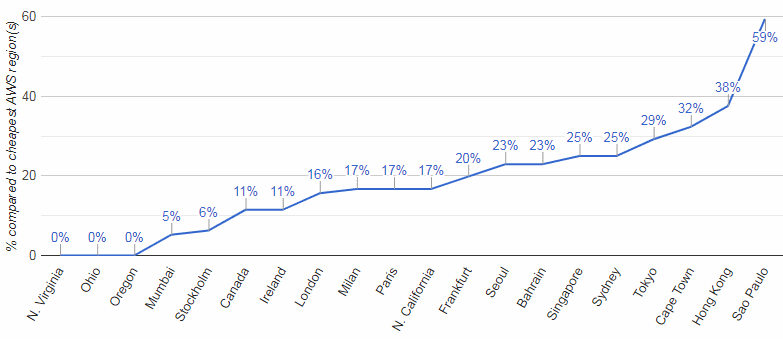
  • Choose the right AWS instance
  • Use spot instances
  • Set sleeping schedules
  • Practice regular Kubernetes cleanup
  • Right-size your Kubernetes cluster
  • Tag resources

… and more. The first step in your Kubernetes cost optimization is to create an outline and begin monitoring them. Then, to avoid unnecessary computational resource usage, you can set limits, which would make the costs more manageable. Incorporating these tips into your processes will result in a cost-optimized Kubernetes system. Good read!

[Read More]

Why reading code is just as important as writing code: How to get better at it

Categories

Tags programming learning teams miscellaneous how-to

It strikes me as odd. We’ve heard the same messages: Write clean code. Write readable code. Write meaningful code. By Amy M Haddad.

Author agrees with these sentiments. But all the talk about writing code overshadows another critical skill: the ability to read it. Reading code is like an athlete who watches their game films. There’s a lot to gain when you become a vast reader.

What you will find in this article:

  • An Important skill
  • Reading vs. doing
  • Reading informs writing
  • Become a Better Reader
  • Follow Ben Franklin’s lead
    • Solve a problem.
    • Find a programmer who’s better than you and who’s solved the same problem.
    • Study their solution. This is a crucial step: read each line of code and type a comment in your editor to explain it.
    • Re-solve the same program after some time has passed. Use the comments you typed out as hints to guide you along the way.
  • Compare your program to the one you studied.
  • Solve problems on LeetCode
  • Recycle your own problems
  • Be a better programmer

Solving problems on the website LeetCode offers an important benefit: it provides in-depth solutions to problems. Oftentimes there are multiple solutions with explanations. A programmer does a lot of things. Writing code is one of them. So is reading it. In the end, being able to read code can help you to write it. It’s circular. Reading code matters and we ought to strive to get better at it. Good read!

[Read More]

How to containerize a local DynamoDb

Categories

Tags serverless nosql docker devops aws

This is going to be a very quick tutorial. I am going to show you how you can use Docker to spin up a DynamoDb. By Phillip Ninan.

This can very useful for prototyping an application where you need to persist some data. Since DynamoDb is a NoSQL database it gives developers a lot of flexibility. Also, if you do plan on using DynamoDb in production this is an easy way to get started without needing to pay.

The tutorial will walk you through:

  • Install locally
  • Create Dockerfile
  • Create docker-compose.yml
  • Start Your Database!
version: '3.7'

services:
  dev:
    container_name: dynamodb
    image: amazon/dynamodb-local
    ports:
      - "8000:8000"
    volumes:
      - dynamodata:/home/dynamodblocal
    command: "-jar DynamoDBLocal.jar -sharedDb -dbPath ."
volumes:
  dynamodata: {}

You can use this to persist data for your latest application or just spin it up to toy around with it. Working code available on author’s Github. Very handful!

[Read More]

DynamoDB checklist

Categories

Tags serverless nosql miscellaneous database aws

DynamoDB is the leading serverless database in the AWS suite of offerings. It provides an easy to configure, high-performance, NoSQL database with low operational overhead and almost endless scalability. By SenseDeep.

DynamoDB appeals to developers requiring a simple serverless database and those requiring the utmost in scalability. However, DynamoDB can be used effectively for almost any OLTP application regardless of scale.

In single-table designs, one database table serves the entire application and holds multiple different application entities. This design pattern offers greater performance by reducing the number of requests required to retrieve information and lowers operational overhead. It also greatly simplifies the changing and evolving of your DynamoDB designs by uncoupling the entity key fields and attributes from the physical table structure.

The article then covers checklists for:

  • Why Single Table?
  • Preparation
  • Data modeling
  • Indexes
  • Data organization
  • Libraries and tooling
  • Coding
  • Performance
  • Infrastructure
  • Migrations
  • Billing
  • Cost control

DynamoDB is a great NoSQL database that comes with a steep learning curve. Folks migrating from SQL often have a hard time adjusting to the NoSQL paradigm and especially to DynamoDB which offers exceptional scalability but with a fairly low-level API. Great one!

[Read More]

How to choose a cloud serverless platform

Categories

Tags serverless cloud cio management

From AWS Lambda and Azure Functions to Knative and OpenFaaS, we have at least a dozen functions-as-a-service platforms to choose from. Here’s how to navigate the options. By Martin Heller.

Enter serverless computing. Serverless computing is an execution model for the cloud in which a cloud provider dynamically allocates—and then charges the user for—only the compute resources and storage needed to execute a particular piece of code.

“Serverless” is of course a misnomer. The model does use servers, although the user doesn’t have to manage them. The container or other resource that runs the serverless code is typically running in a cloud, but may also run at an edge point of presence. The article will guide you through following:

  • Serverless computing pitfalls
  • AWS Lambda and related services
  • Microsoft Azure Functions
  • IBM Cloud Functions
  • Oracle Cloud Functions and the Fn Project
  • Cloudflare Workers
  • Serverless Framework
  • Apache OpenWhisk
  • Fission

Function as a service (FaaS) describes many serverless architectures. In FaaS, the user writes the code for a function, and the infrastructure takes care of providing the runtime environment, loading and running the code, and controlling the runtime lifecycle. A FaaS module can integrate with webhooks, HTTP requests, streams, storage buckets, databases, and other building blocks to create a serverless application. Great read!

[Read More]